
BenchmarkPro Performance Audit
Introducing a new audit-grade deliverable to quantify BESS underperformance and validate operator decisions.
Read Full Announcement →Published
Understanding the difference between generic market averages and a physics-aware P&L baseline tailored to your specific battery asset.
Most revenue benchmarks in the market today are generic. They take a standard battery profile (e.g., 2-hour duration, 85% efficiency) and run it against historical prices. While useful for a high-level view, this approach fails to capture the reality of operating a specific asset.
Your battery has unique constraints: specific degradation curves, inverter limitations, grid connection limits, and warranty conditions. Ignoring these leads to a 'confidence gap' between the theoretical revenues shown in a pitch deck and the actual P&L on your bank statement.
An asset-specific benchmark creates a 'digital twin' of your BESS. It simulates the exact same physical and commercial constraints your operator faces. If your battery couldn't cycle because of a temperature limit or a warranty constraint, the benchmark shouldn't assume it made money during that hour.
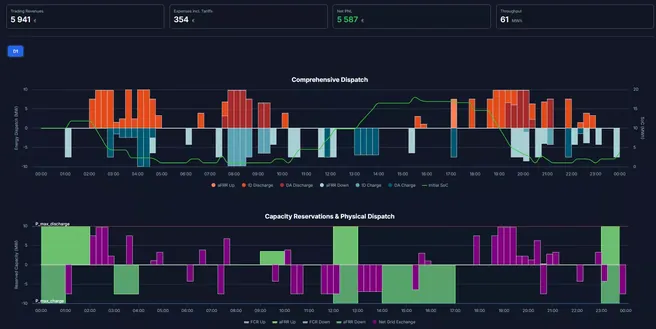
Moving to an asset-specific model allows you to answer critical commercial questions:
Introducing a new audit-grade deliverable to quantify BESS underperformance and validate operator decisions.
Read Full Announcement →Analysis of a utility-scale battery operating in the French market. Discover how aFRR price spikes drove performance.
Read Case Study →Tell us what insights you need or what you would like to see in our Benchmarks.
Book a meetingOr write to contact@forsytenergy.com and we will get back to you.